Three Cheers For Positive Training: Compassion, Patience, Consistency
Many things, such as breed, age, history and nutrition, as well as the owner’s skill and consistency, affect a monkey’s behavior and learning ability. Positive training employs kind, stress-free methods of shaping a monkey’s behavior. Praise, grooming and life rewards (playing games with toys or balls, running loose in an enclosed garden, a car ride etc.) are some of the rewards a monkey gets for good behavior.
Positive training with rewards is less stressful all around, for monkeys and owners alike. Discipline is the key to positive training. It makes positive associations so your monkey bonds with you and looks at life as friendly.
Positive trainers use the NILIF leadership model: Nothing In Life Is Free. Especially food. A monkey who earns ALL of its food (every bite) is a monkey who is learning to behave well among others.
The messages you want to get across to a monkey are,
1. “I own everything in life you want.”
2. “You must do something for me first in order to get what you want.”
Implicit in these messages are: “Trust in me. I have your best interest at heart and will never hit, kick, shock or abuse you.”
What are some simple things your monkey can do for you?
You want to get groomed? “Sit.” Then I’ll groom you.
You want a treat (nutritious food reward)? Sit here, then I’ll give you a treat.
You want a treat? Get your leash on, then I’ll give you a treat.
You want a treat? First take a bath, then I’ll give you a big treat.
Want to chase the ball outside? Hold still while I put your leash on, then you’ll get a treat.
Even if your monkey only sits for an instant, he is learning to do what you ask before he gets his chopped vegetables or monkey chow. Even adult monkeys like mona guenon Sasha have learned to sit before getting a hand fed treat.
Start by teaching your monkey to sit calmly when you offer food. You don’t want the monkey to lunge forward and grab the food but to sit in play calmly while you bring the food to his or her mouth. Use foods that are part of forming a good diet. Cup the food in your hand and bring it all the way to your monkey’s mouth. Push gently back at your monkey’s head if the head has come forward.
Although young and rambunctious, patas monkey Bhuti, below, will sit numerous times to get a hand-fed treat, such as a piece of hard boiled egg white (a favorite food).
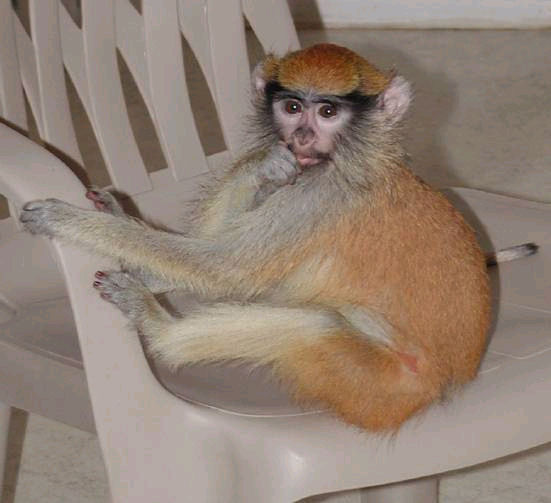
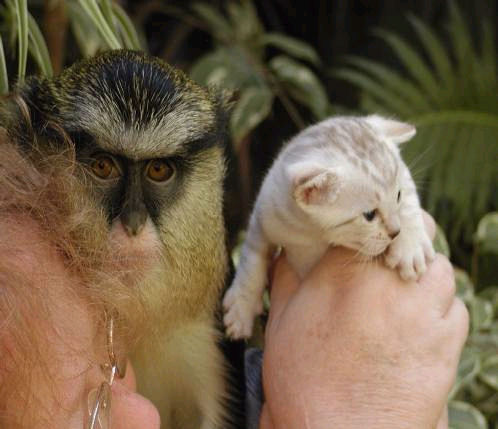
Other behaviors to reward: Reward a money spontaneously for being “good-calm”. Mona guenon Sasha, below is rewarded for good-calm behavior when playing with her friend Jacquie and kitten Charmaine.
Monkeys, especially Old World monkeys and even more so, Old world ground dwelling monkeys like vervet and patas, can benefit greatly from learning to walk on a leash like a dog. This is provided that you have a monkey-safe place to walk your primate, either in a fenced area or an uncrowded area where big dogs do not run free.