Monkey Trails
At the World Famous San Diego Zoo, you can enter the new Monkey Trails exhibit to the left of the flamingos winding water bed. But for the primate lover, it is preferable to veer to the right of the flamingoes. That will allow you to pass by a langur exhibit and visit absolutely Apes as well. Absolutely Apes is an enclosure with a bark-like substrate which houses orangutans and siamangs in an interactive environment. After visiting absolutely Apes, enter Monkey Trails by way of the Asian forest pathway that begins across from absolutely Apes. From monkey trails winding paths, the trails emanate on several levels. The endangered black mangabeys, aerial acrobats from the Democratic Republic of Congo, are built to hang out in trees and promise to be an important breeding group for the future. Five black mangabeys including two males and three females, came to the San Diego zoo from Burgers’ Zoo in the Netherlands. Only one male will be out at a time.
Sharing the mangabey enclosure is another primate species native to Democratic Republic of Congo, the Schmidt’s lesser spot-nosed guenons, also called red-tailed guenons.
Next are the seriously endangered mandrills, one of the largest, most colorful of the African monkeys with their striking red and blue faces—and matching hind quarters. An example of sexual dimorphism, the males and female mandrills look very different. Female mandrills are much less colorful and smaller by half than their male counterparts. In the wild, these 20 to 30 pound females and 40 to 60 pound male mandrills live in multi-generational groups of both Males and females. The San Diego Zoo’s existing group of four mandrills is to be joined by two young males coming from the Quebec Zoo.
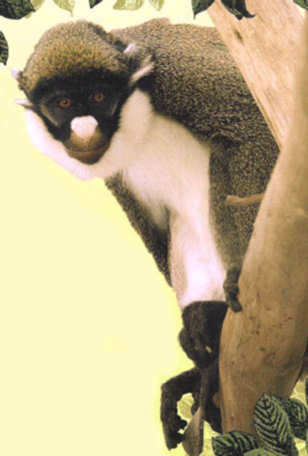
Also sharing their habitat are the enchantingly beautiful full-bearded lesser spot-nosed guenons from western Africa. Along with the Schmidt’s guenon these two guenons are a tiny representation of the whole guenon family, which as the most diverse group of primates in Africa, and includes approximately 38 species.
Further down the Monkey Trails path you will find the swamp swimming golden-bellied mangabeys from Democratic Republic of Congo and the L’Hoest’s guenons from the mountains of Central Africa.
The golden bellied mangabeys are a very different species and genus from the black mangabeys. As semi-terrestrial primates they represent the “white eyelid group”. If they stare at you with a flash of their white eyelids, be aware that you should not stare back. A direct stare is considered a threat and will stress this species. Their white eyelids are intended to add intimidation to their direct stare. This group includes two mothers and two offspring.
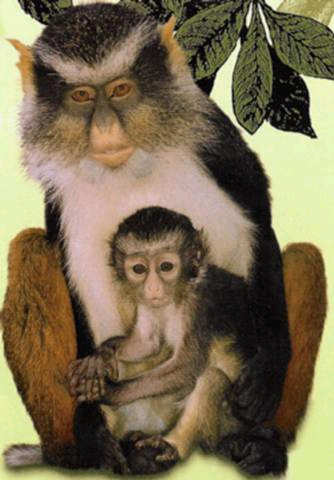
At the western end of monkey Trails, you will find another primate species, the Wolf’s mona guenon, a delightful monkey with ear-tufts which add to its imp-like appearance. This enclosure houses breeding Wolf’s monas, who have produced at least one offspring to date.
Among the birds and other delightful creatures, the Monkey Trails visitor will also find a series of large signs along the way, representing entries from field researchers’ journals. Some of the stories have been used verbatim, come have been shortened and others combines to convey some funny, some harrowing and some magical moments in real life forest field research….The End

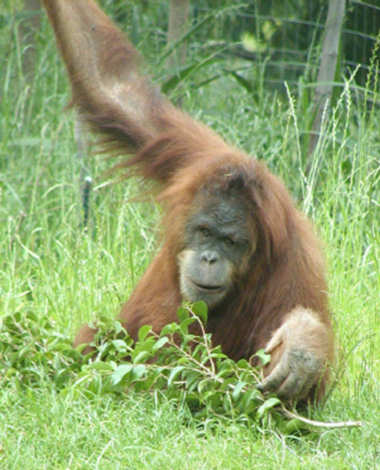
 an adult female siamang, left, and an adult
female orangutan, middle, cohabit the Absolutely Apes exhibit at the San Diego
Zoo. The golden-bellied mangabey,
far right, from the “white eyelid group’ pf
mangabeys, is found in the Monkey Trails exhibit.
an adult female siamang, left, and an adult
female orangutan, middle, cohabit the Absolutely Apes exhibit at the San Diego
Zoo. The golden-bellied mangabey,
far right, from the “white eyelid group’ pf
mangabeys, is found in the Monkey Trails exhibit.
The showy male mandril, bottom left, a female wolf’s mona guenon with offspring, middle and an adult male lesser spot-nosed guenon, bottom right, all inhabit areas in the Monkey Trails exhibit.